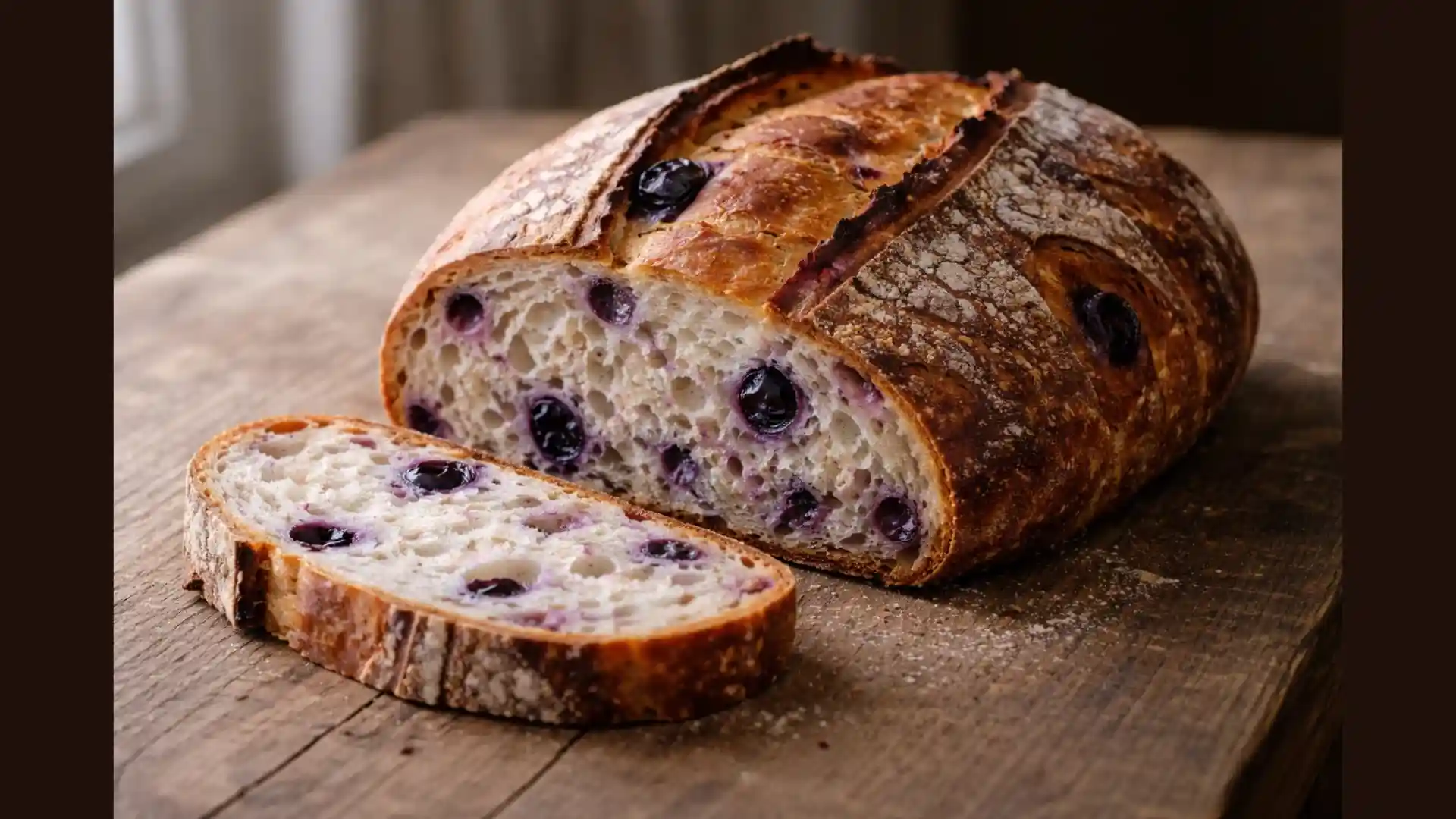
If you’ve ever bitten into a bakery fruit sourdough—thin, crackly crust; open, custardy crumb; pockets of jammy blueberry; a faint lemon perfume—and wondered why your homemade version turns gummy, purple, or flat, this guide is for you.
This is a true artisan sourdough loaf (not a quick bread). It’s built around the same core entities professional bakers obsess over: starter strength → dough temperature → gluten development → fermentation timing → inclusion strategy → bake physics. Get those right, and blueberries stop being “a messy add-in” and start being a controlled, high-impact flavor layer.
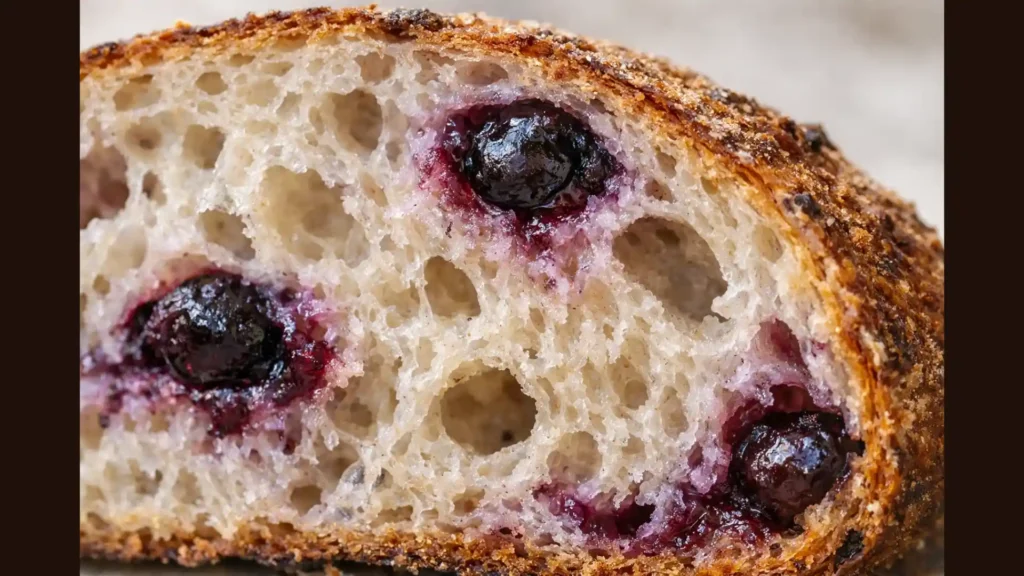
Featured Snippet (Quick Answer)
How do you make blueberry sourdough bread without it turning gummy?
- Use an active, peak starter (not discard).
- Keep hydration moderate (65–70%) so berry juice doesn’t collapse structure.
- Add blueberries after gluten begins forming (2nd fold or lamination), not at initial mix.
- Prefer fresh berries; if using frozen, add them unthawed and later.
- Bake hot in a preheated Dutch oven and cool fully before slicing.
Entity Map (How This Article Covers Search Intent)
Think of this as your “knowledge graph” for blueberry sourdough:
- Blueberry Sourdough Bread (core entity)
- Sourdough Starter (active, ripe, peak; feeding; maturity signals)
- Dough Formula (hydration, salt %, flour protein, sugar optional)
- Fermentation (bulk, cold proof, temperature, rise cues)
- Gluten Development (autolyse, folds, lamination, tension)
- Inclusions (fresh vs frozen vs dried blueberries; lemon zest; cinnamon; honey; nuts)
- Baking (Dutch oven, steam, oven spring, scoring, internal temp)
- Troubleshooting (gummy crumb, dense loaf, burnt berries, purple smear, leaking juice)
- Storage (counter, freezer, reheating)
- FAQ + long-tail queries (same-day schedule, no Dutch oven, all-purpose flour, etc.)
The Bakery-Level Blueberry Sourdough Recipe (1 Loaf)
Baker’s Formula (with percentages)
This helps you scale and also signals “expert mode” to both humans and algorithms.
| Ingredient | Weight | Baker’s % |
|---|---|---|
| Bread flour (or strong AP) | 500 g | 100% |
| Water | 330–350 g | 66–70% |
| Active sourdough starter (100% hydration) | 100 g | 20% |
| Salt | 10 g | 2% |
| Blueberries (fresh) | 125–175 g | 25–35% |
| Optional: honey or sugar | 15–30 g | 3–6% |
| Optional: lemon zest | 6–12 g | — |
Why these numbers work: blueberries bring extra moisture + acidity + physical “gluten cutting”. A moderate hydration dough gives you the open crumb you want without collapsing into a gummy, fruit-stained interior.
Ingredients (plain-English shopping list)
- 500 g bread flour (or high-protein all-purpose)
- 330–350 g water, room temp
- 100 g active sourdough starter, bubbly and near peak
- 10 g salt
- 125–175 g fresh blueberries, rinsed + very well dried
- Optional: 15–30 g honey/sugar (soft sweetness)
- Optional: lemon zest (the “bakery aroma” lever)
Tools (best results):
- Dutch oven (or combo cooker), banneton (or towel-lined bowl), lame/razor, kitchen scale, instant-read thermometer.
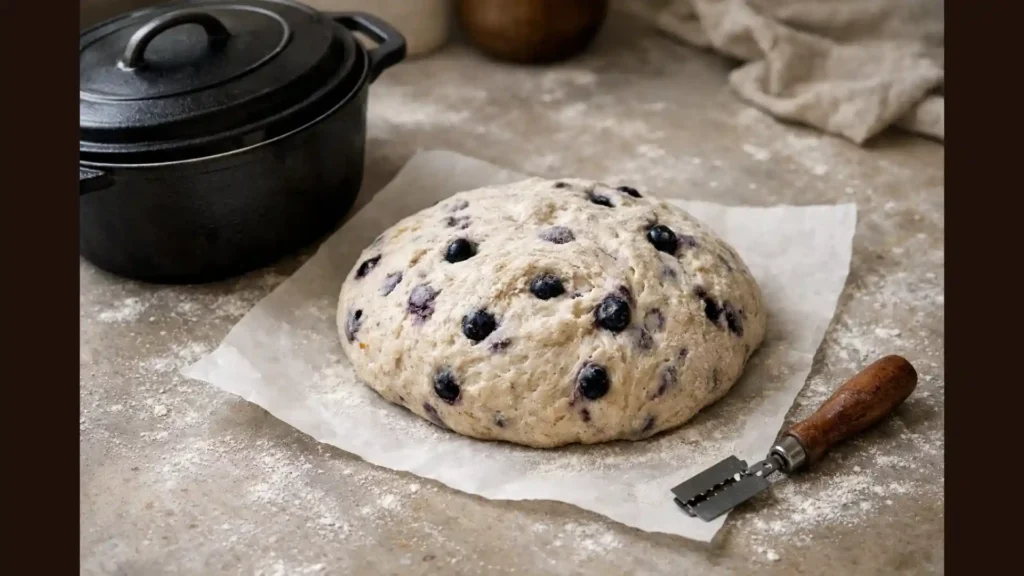
Step-by-Step Method (with the “why” baked in)
1) Prep: Make sure your starter is truly ready
A blueberry loaf is less forgiving than a plain country loaf. You want starter that:
- rises predictably after feeding,
- looks aerated (not watery),
- smells sweet-tangy, not sharply acidic,
- passes the “peak behavior” test: it’s near its highest rise and still strong.
Behavioral cue: if your starter is sluggish, you’ll compensate by over-proofing… and blueberries will punish that with gumminess.
2) Mix (5 minutes) + Rest (20–40 minutes)
In a bowl:
- Mix water + starter (and optional honey/sugar + lemon zest).
- Add flour + salt.
- Stir until no dry flour remains.
Cover and rest 20–40 minutes.
Why this matters: this rest (a mini-autolyse) begins gluten formation early, so later you can fold in blueberries with less tearing.
3) Strength-Building (2–2.5 hours): folds + inclusion strategy
You’ll do 3–4 sets of folds, spaced every 30 minutes.
The inclusion moment (where most loaves are won or lost)
Add blueberries after the dough has some structure—typically during the 2nd fold.
Option A: Gentle “fold-in” (fast, beginner-friendly)
- Scatter blueberries over the dough.
- Fold from four sides until berries are tucked in.
- Stop once distributed; don’t chase perfection.
Option B: Lamination (bakery method, best distribution)
- Lightly wet the counter.
- Stretch dough into a thin rectangle without tearing.
- Sprinkle blueberries evenly.
- Fold like a letter, then fold again.
- Return to bowl.
Why blueberries get added later: early mixing smashes fruit, releases juice, and turns your dough into a purple slip’n’slide.
4) Bulk Fermentation (until “alive,” not just bigger)
Bulk isn’t a timer—it’s a set of observable changes.
Look for these cues:
- Dough is jiggly and aerated at the edges
- Surface becomes smoother and slightly domed
- Volume increase roughly 30–60% (not necessarily doubled)
- Dough feels lighter and elastic when you lift it
Temperature reality: bulk time depends mostly on dough temperature and starter strength. A warmer dough ferments faster; a cooler dough needs more time.
Pro move: Use an aliquot jar (small sample of dough in a marked jar). When it rises ~50%, you’re in the zone.
5) Pre-shape → Bench Rest → Final Shape (create tension, protect berries)
Turn dough out gently. Pre-shape into a round, rest 15–25 minutes, then final shape (boule or batard).
Key shaping rule: Try to keep berries inside, not poking out. Exposed berries burn and can create bitter spots on the crust.
Place seam-side up in a floured banneton.
6) Cold Proof (12–20 hours): flavor + scoring control
Refrigerate the shaped loaf, covered, for 12–20 hours.
Why cold proof works especially well here:
- develops lactic acidity that complements blueberries,
- firms the dough for clean scoring,
- slows fermentation so berries don’t over-soften the structure.
7) Bake: Dutch Oven, high heat, strong steam
- Preheat oven + Dutch oven to 500°F (260°C) for 45–60 minutes.
- Turn out cold dough onto parchment.
- Score (one confident cut is better than many hesitant ones).
- Bake:
- Covered: 20 minutes at 500°F
- Reduce to 450°F (232°C)
- Covered: 10 more minutes
- Uncovered: 15–20 minutes until deep golden
Doneness target (anti-gummy insurance)
- Internal temp: 208–210°F (97–99°C)
- Crust: deep amber, feels firm (not pale)
Cool completely (at least 90 minutes) before slicing.
Fresh vs Frozen vs Dried Blueberries (Best Practices)
Fresh blueberries (best “bakery look”)
- Dry them thoroughly.
- Add mid-bulk via lamination or folds.
Frozen blueberries (works, but requires strategy)
If using frozen:
- Keep them frozen (do not thaw).
- Add later (lamination is best).
- Expect some color bleed; it’s normal.
Dried blueberries (best structure, most consistent crumb)
- Soak briefly in warm water or tea, then drain and pat dry (optional).
- They won’t leak like fresh berries, so crumb is often more open.
Flavor Variations That Match Search Intent (and Actually Work)
Lemon Blueberry Sourdough
- Add lemon zest (6–12 g) at mix.
- Optional: a small amount of honey (15–30 g) to round acidity.
Avoid dumping lemon juice into the dough unless you know how to rebalance hydration and fermentation speed—acid can tighten gluten and shift fermentation behavior.
Blueberry Cinnamon Sourdough
- Add 1–2 tsp cinnamon (mixed with flour).
- Cinnamon can slightly inhibit yeast activity; keep fermentation cues in mind.
Blueberry Walnut Sourdough
- Add 75–100 g toasted walnuts with blueberries.
- Toasting removes harshness and amplifies aroma.
Troubleshooting (Read This If You Want “Bakery-Level” Consistency)
“My crumb is gummy.”
Most common causes:
- Underbaked loaf (pale crust, low internal temp)
- Sliced too early
- Over-hydrated dough + juicy berries
- Under-fermented bulk (structure never fully developed)
Fix:
- Bake darker; verify internal temp.
- Cool longer.
- Use fresh, dried berries, or reduce water by 10–20 g next time.
“My loaf is dense and tight.”
Most common causes:
- Starter not at peak
- Bulk ended too early (insufficient gas + gluten maturity)
- Dough too cold through bulk
Fix:
- Strengthen starter routine.
- Extend bulk until you see aeration and jiggle.
“Blueberries all sank / clumped.”
Causes:
- Added too early (dough too slack)
- Poor distribution (dumped in as one pile)
- Overhandling during shaping
Fix:
- Use lamination.
- Scatter evenly and fold gently.
“My crust burned where berries touched.”
Fix:
- Tuck berries in during shaping.
- Dust banneton well to prevent tearing when turning out.
Schedules (Because Time Is the Real Ingredient)
The Classic Two-Day Schedule (best flavor + control)
Day 1
- Morning: feed starter
- Early afternoon: mix dough
- Afternoon: folds + bulk
- Evening: shape + refrigerate
Day 2
- Morning: bake straight from fridge
- Late morning: slice after full cool
Same-Day “I Need It Tonight” Schedule (works if starter is strong)
- Mix early morning
- Bulk during the day (warmer dough)
- Shape late afternoon
- Short chill (optional, 1–2 hours) for scoring
- Bake evening
Same-day loaves are less flavorful but still excellent when fermentation is managed.
Serving Ideas (the emotional payoff)
This bread lives at the intersection of breakfast comfort and artisan craft:
- Toast + salted butter (simple, perfect)
- Toast + ricotta + honey (bakery café energy)
- French toast with blueberry sourdough (ridiculously good)
- Savory pairing: goat cheese + cracked black pepper (don’t knock it)
Storage (so it stays “bread,” not “blueberry sponge”)
- Day 1: store cut-side down on a board or in a paper bag.
- Days 2–3: wrap in a cloth or keep in a bread box.
- Freeze: slice first, then freeze. Toast from frozen.
Avoid sealing in plastic while warm—it softens crust and can make the crumb feel tacky.
Sourdough Loaf Flavors: 37 Creative Ideas to Bake
FAQ (Conversational Long-Tail Coverage)
Can I make blueberry sourdough bread with sourdough discard?
Not for this artisan loaf. Discard loaves are typically quick breads (baking powder + loaf pan). This recipe needs active starter for fermentation and structure.
Do I need a Dutch oven?
A Dutch oven is the easiest way to get bakery steam at home. If you don’t have one, bake on a stone/steel and add steam with a preheated tray (more variables, but doable).
Can I use all-purpose flour?
Yes, but choose a higher-protein AP if possible. Expect slightly less height and a tighter crumb than bread flour.
Why is my dough turning purple?
Color bleed happens when berries pop (more common with frozen). It’s cosmetic, not a failure.
Should I add sugar?
Optional. A small amount (3–6%) boosts perceived blueberry flavor and browning without turning the loaf into dessert bread.